
The holistic, human-centred approach
Commitment to the integrated approach is the core methodology for addressing development issues, including water issues and SDG 6, and for ensuring that people are the focus of attention (the starting point and the ultimate goal). This approach must remain present in the background of thinking during analysis and planning, as well as when dealing in detail with individual targets, policy-making, and adopting practical, applied interventions and projects; this does not mean sidelining this integrated background. The figure below presents a visual representation of what we consider a people-centred integrated approach, covering the main aspects (not all aspects) of the place of water in the development and rights trajectory.
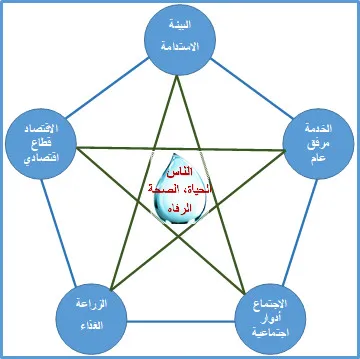
In this figure, people (especially the current generation, and future generations) are the focus of attention. For them, water means survival and life, health, and well-being. Water is addressed from five angles:
- A public service that must be provided through public utilities.
- Having water and sanitation available inside the home can free up a substantial portion of household members’ time, especially women and girls in rural areas not connected to networks, enabling them to use that time for other activities.
- Water is linked to agriculture, which is assumed to be sustainable, and water is also a key contributor to food production which, in turn, sustains health through good nutrition.
- Water An economic matter in three senses, the first being its fundamental contribution to agriculture. As a productive sector. It is considered an input to production. The second is the shares consumed by other sectors, especially industry, energy, and tourism, which also depends on prevailing economic patterns that must be assessed according to the criterion of water-resource consumption and depletion, alongside other criteria. The third is the transformation of water itself—especially drinking water—into a profit-making sector through its privatization and the widespread expansion of private bottled-water companies at the expense of water availability through public networks. This makes the water sector itself a profit-driven sector over which global companies compete.
The environmental dimension, which in turn affects the following issues:
- Direct pollution of water and its sources, causing diseases and epidemics;
- Waste resulting from dilapidated networks, which reduces the individual’s share of necessary consumption according to global standards; in addition, dilapidated networks are a common source of pollution;
- Water stress resulting from failure to observe sustainability requirements in water and water-resources management, whether through excessive withdrawal and consumption beyond their capacity to renew, poor selection of water-harvesting methods (such as dams in many cases), or consumption according to misguided priorities.